


TL;DR
SnapGene is a tool for visualizing and planning molecular biology work. Some labs need different collaboration, integration, deployment, analytics, or lab management capabilities, while others want to retain SnapGene and connect it to a wider operating context. Evaluating alternatives can lead to replacement, continued specialist use, or a deliberate mixed stack.
This guide covers seven distinct alternatives in 2026. It does not assume every lab should replace SnapGene or that a broader platform reproduces every specialist molecular biology function. The goal is to test capabilities, connectivity, operating model, and total cost against real workflows.
Sequence editors versus lab operating systems
List the SnapGene tasks used today, such as plasmid maps, sequence annotation, primer design, cloning simulations, alignments, file sharing, and recordkeeping. Separate essential functions from occasional conveniences. Note the file formats exchanged with colleagues, CROs, instruments, ELNs, or repositories.
Then identify the reason for evaluating alternatives. A team seeking deeper bioinformatics has different needs from one seeking cloud collaboration or an integrated lab operating system. This distinction prevents a broad platform from being judged only as a sequence editor, or a specialized tool from being expected to manage the entire lab.
Map Your Sequence Workflow Before Replacing SnapGene
Not every lab needs a complete SnapGene replacement. Map how plasmid maps, sequence versions, primers, constructs, samples, and experiments move through your workflow before choosing a new platform.
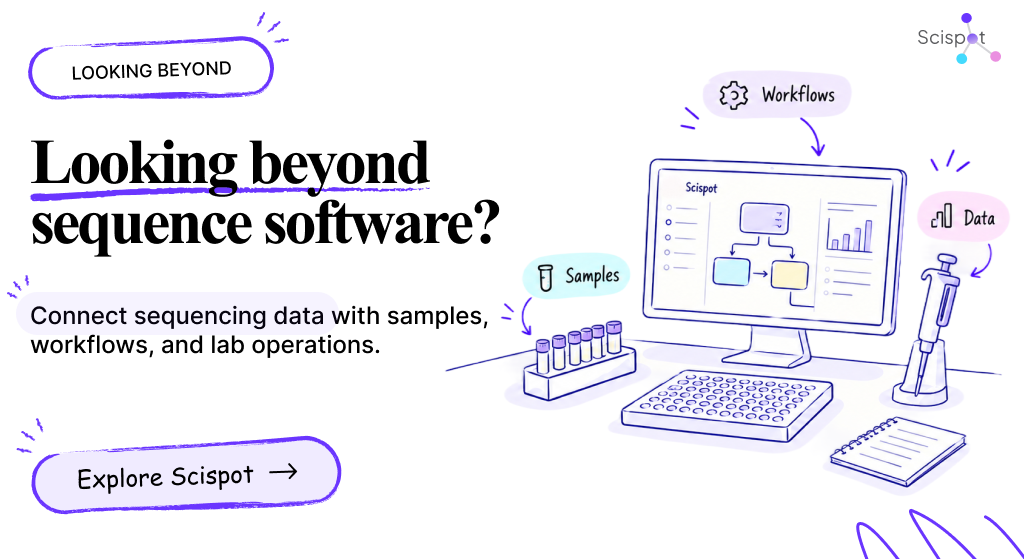
Explore Scispot LIMS for Molecular Biology Labs
.png)
7 SnapGene alternatives to evaluate in 2026
1. Scispot
Scispot combines molecular biology context with LIMS, ELN, SDMS, inventory, quality workflows, and integrations. A lab may use native Scispot applications while retaining SnapGene or another specialist sequence tool, then coordinate sequence versions and constructs with samples, methods, experiments, instrument outputs, results, approvals, and reports. Buyers should test required molecular biology functions directly because Scispot does not claim to replace every specialist function.
2. Benchling
Benchling offers molecular biology and research informatics products. Teams can evaluate sequence design, shared records, collaboration, structured data, and connections to wider research workflows. Confirm current packaging, academic or commercial eligibility, exports, integrations, implementation services, and total cost in writing.
3. Geneious Prime
Geneious Prime focuses on sequence analysis and bioinformatics workflows. Buyers can test assembly, annotation, alignments, variant analysis, plugins, supported file formats, and collaboration needs with representative data. Teams that also need sample, inventory, or quality workflows should determine how Geneious will exchange data with those systems.
Comparing Sequence Tools? Evaluate the Full Lab Workflow
Sequence editing is only one part of molecular biology operations. Use a structured evaluation to compare file compatibility, annotations, collaboration, sample traceability, integrations, and downstream reporting.
Get the LIMS Evaluation Checklist
4. Galaxy
Galaxy is an open-source, web-based platform for reproducible computational biomedical analysis. Its public tool ecosystem can support many bioinformatics workflows. Buyers should distinguish between using a public server and operating a managed or internal environment, then assess administration, security, compute, support, reproducibility, and the skills required for their intended analyses.
5. ApE
ApE, or A Plasmid Editor, is a specialized option for plasmid and sequence work. It may cover common editing and visualization tasks for some researchers. Teams should test current operating-system compatibility, file exchange, collaboration, support expectations, and whether additional tools are needed for experiment records, samples, and workflow management.
6. Serial Cloner
The official Serial Cloner download page provides version 2.6.1 as-is and unsupported, making it a legacy option for sequence, alignment, PCR, and cloning tasks. Buyers should verify operating-system compatibility, file exchange, documentation, security expectations, and available support before relying on it in a current workflow.
Move Beyond Standalone Sequence Files
If your team relies on shared folders, desktop applications, or manually maintained records, consider how sequence versions connect to constructs, samples, experiments, approvals, and final results.
See How Scispot Connects Lab Data
7. UGENE
UGENE is an open-source bioinformatics platform with sequence analysis and workflow capabilities. Teams can evaluate its tools, file formats, workflow designer, compute requirements, deployment options, community resources, and support model. Regulated or production use may require additional governance, validation, and operational ownership.
Specialized tool or integrated platform?
A specialized molecular biology tool can be appropriate when sequence work is the primary requirement and researchers already have reliable systems for experiments, samples, inventory, and quality. Specialized applications may provide focused interfaces and scientific functions without introducing broader process changes.
An integrated platform can be appropriate when the lab wants molecular biology context connected with samples, methods, results, approvals, and reports. Integration can reduce duplicate entry, but only if the platform supports the required scientific detail and the lab has a clear data model. Buyers should test both scientist and administrator workflows.
For Scispot, the broader platform role is coordination rather than universal specialist replacement. Sequence versions and constructs can remain linked to samples, methods, experiments, instruments, results, approvals, reports, and downstream decisions. Labs can use native Scispot LIMS, ELN, SDMS, inventory, and quality apps, connect SnapGene or other retained systems, or combine both paths. Scispot calls this connected, traceable, automation-ready, and AI-ready foundation the lab's Digital Brain.
Keep Your Preferred Sequence Tool. Connect the Rest of Your Lab.
You don't necessarily need to replace SnapGene to improve lab operations. Scispot can help molecular biology teams connect sequence and construct context with samples, experiments, inventory, instrument data, approvals, and reports.
See a Connected Molecular Biology Workflow
Integration criteria
For each alternative, document the systems that must exchange data, the direction of each exchange, the file or API format, frequency, ownership, and error handling. Ask vendors to demonstrate a complete transfer with representative data. Statements about thousands of possible integrations are less useful than evidence for the specific connections your lab needs.
Also evaluate identifiers and relationships. A sequence version should remain connected to its construct, sample, method, experiment, instrument output, result, approval, and report. Confirm how changes are tracked, which system owns each object, and how users recover context during search, review, handoff, or export.
Test Your Integrations With Real Lab Data
Before selecting a SnapGene alternative, test how your sequences, constructs, samples, instruments, and experimental results actually move between systems. A successful workflow should preserve context—not create another data silo.
Explore Scispot Integrations
Collaboration and deployment
Desktop and web-based tools have different operating profiles. Evaluate concurrent work, version control, comments, permissions, remote access, offline needs, data residency, backup, and disaster recovery. Do not assume that cloud deployment automatically solves collaboration or that desktop deployment prevents it; test the actual workflow and governance model.
AI and automation
AI-assisted features should be tested against defined use cases rather than broad predictions. A lab might evaluate natural-language search, report drafting, workflow assistance, or data summarization. Confirm which data the feature can access, how permissions apply, whether prompts and outputs are retained, and where scientific review is required.
Scispot offers Scibot as an AI interface within its platform. Buyers should ask for a current demonstration using approved sample data and verify which actions are available in their proposed package. Similar scrutiny should be applied to AI claims from every vendor.
Implementation and administration
Implementation timelines depend on scope, migration, integrations, validation, training, and internal availability. Request a written plan with responsibilities, milestones, acceptance criteria, and assumptions. For open-source or desktop tools, include internal installation, updates, support, and governance work that may not appear in a vendor proposal.
Evaluate More Than Features
The best SnapGene alternative should also fit your implementation capacity. Assess configuration, migration, integrations, permissions, validation, and ongoing administration before committing to a new system.
See How Scispot Supports Modern Lab Operations
Ask who can configure templates, data models, permissions, and workflows. Determine how changes are tested and promoted, how integrations are monitored, and how users receive support. Administrative effort is part of total cost even when licensing is free.
Pricing and total cost
Use current quotes or published vendor pages for pricing. Compare licenses, subscriptions, hosting, implementation, migration, integrations, validation, training, support, compute, storage, and internal labor over the same period. Mark unknown values rather than inserting estimates from unattributed discussions.
A practical evaluation scorecard
- Required sequence and molecular biology functions
- File compatibility and data portability
- Experiment, sample, and inventory context
- Collaboration, permissions, and version history
- Integrations and error handling
- Deployment, security, backup, and support
- Administration and change management
- Implementation effort and total cost
Weight these criteria before demonstrations. Use the same scenarios and sample data for every vendor, and involve the scientists and administrators who will perform the work.
Migration and file compatibility
A sequence tool migration should begin with an inventory of files, formats, annotations, custom features, naming conventions, and linked documents. Select representative simple and complex records, then import them into each candidate. Verify that sequence orientation, features, colors, primers, notes, references, and history remain understandable after transfer.
Do not treat a successful file opening as complete migration evidence. Compare the source and destination visually and structurally, document unsupported fields, and decide whether transformations are acceptable. Confirm how batch imports work, how duplicates are handled, and whether users can trace an imported record back to its source.
Versioning and collaboration tests
Ask two users to edit related work, add comments, share records, resolve a conflict, and recover an earlier version. Test access for internal teams and external collaborators without exposing confidential production data. If the tool relies on shared folders or manual naming, document the conventions and controls needed to prevent ambiguity.
Finally, export the pilot records into common formats and open them outside the candidate system. Include annotations and metadata in the review. A platform that accepts many inputs but cannot produce usable outputs may create future operational work, so portability deserves the same attention as import.
Include current SnapGene users in the final review. Ask them to compare task time, scientific clarity, collaboration, and error recovery, while documenting any functions that would still require SnapGene or another tool. A mixed-tool outcome can be valid when responsibilities and file exchange are clear; replacement should not be treated as the only successful result.
Modernize Your Molecular Biology Lab Workflow in the United States
From biotech companies to established research organizations across the United States, molecular biology teams need connected systems for sequence context, samples, experiments, inventory, and reporting.
Talk to a Scispot Lab Workflow Expert
Conclusion
The best SnapGene alternative depends on the problem. Benchling, Geneious Prime, Galaxy, ApE, Serial Cloner, and UGENE offer different combinations of molecular biology, bioinformatics, deployment, and support. Scispot offers a broader coordination approach that can connect molecular biology context with wider operations while allowing a specialist sequence tool to remain.
Labs considering Scispot can request a demo of sequence-version and construct traceability across samples, methods, experiments, results, approvals, and reports, including a retained SnapGene workflow.
Third-party product and company names are used for identification only. Scispot is not affiliated with, endorsed by, or sponsored by the vendors mentioned. Product details, pricing, and implementation timelines may change, so buyers should verify information directly with each vendor.



%20Comprehensive%20Guide.avif)
.webp)